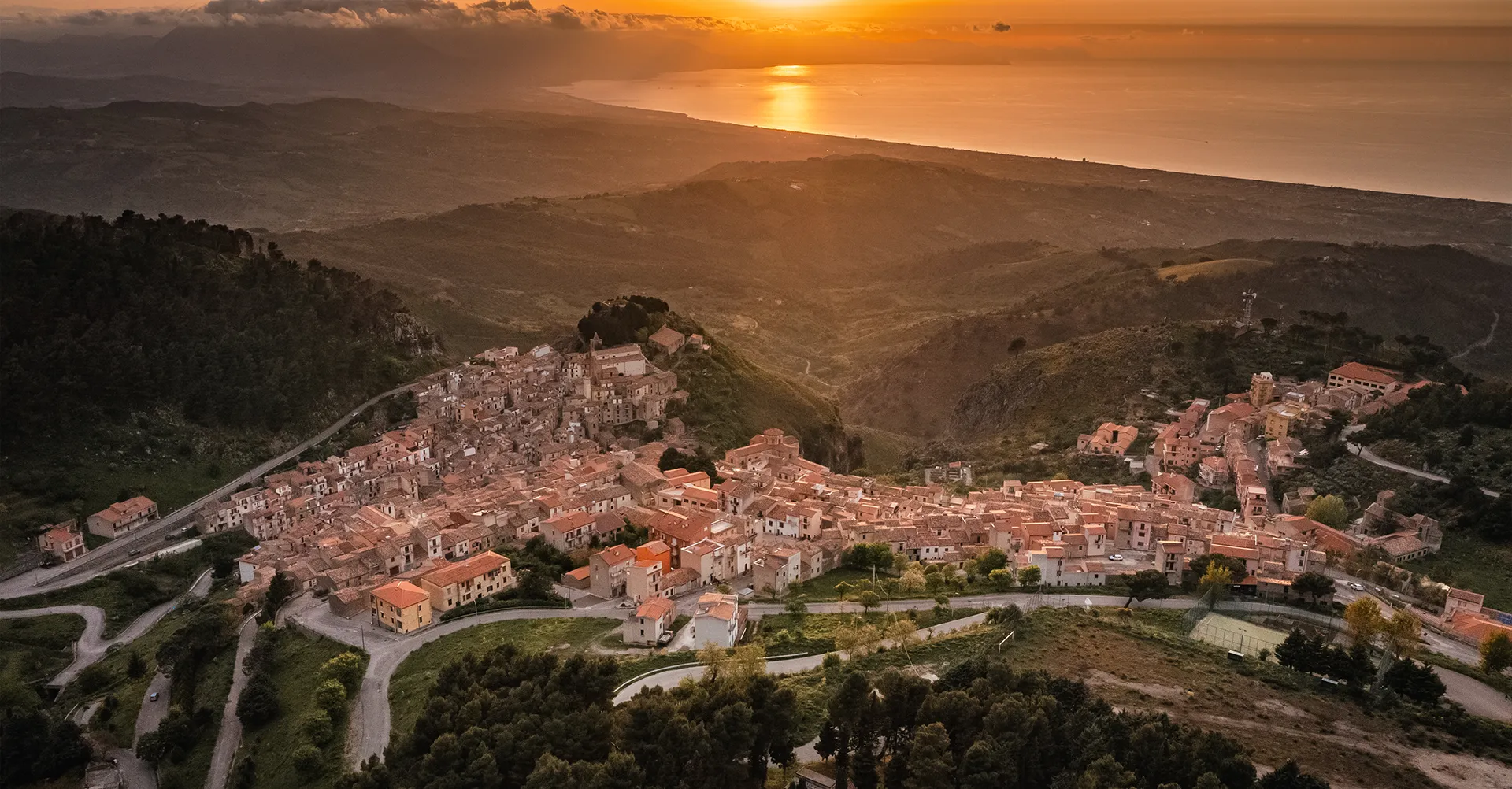
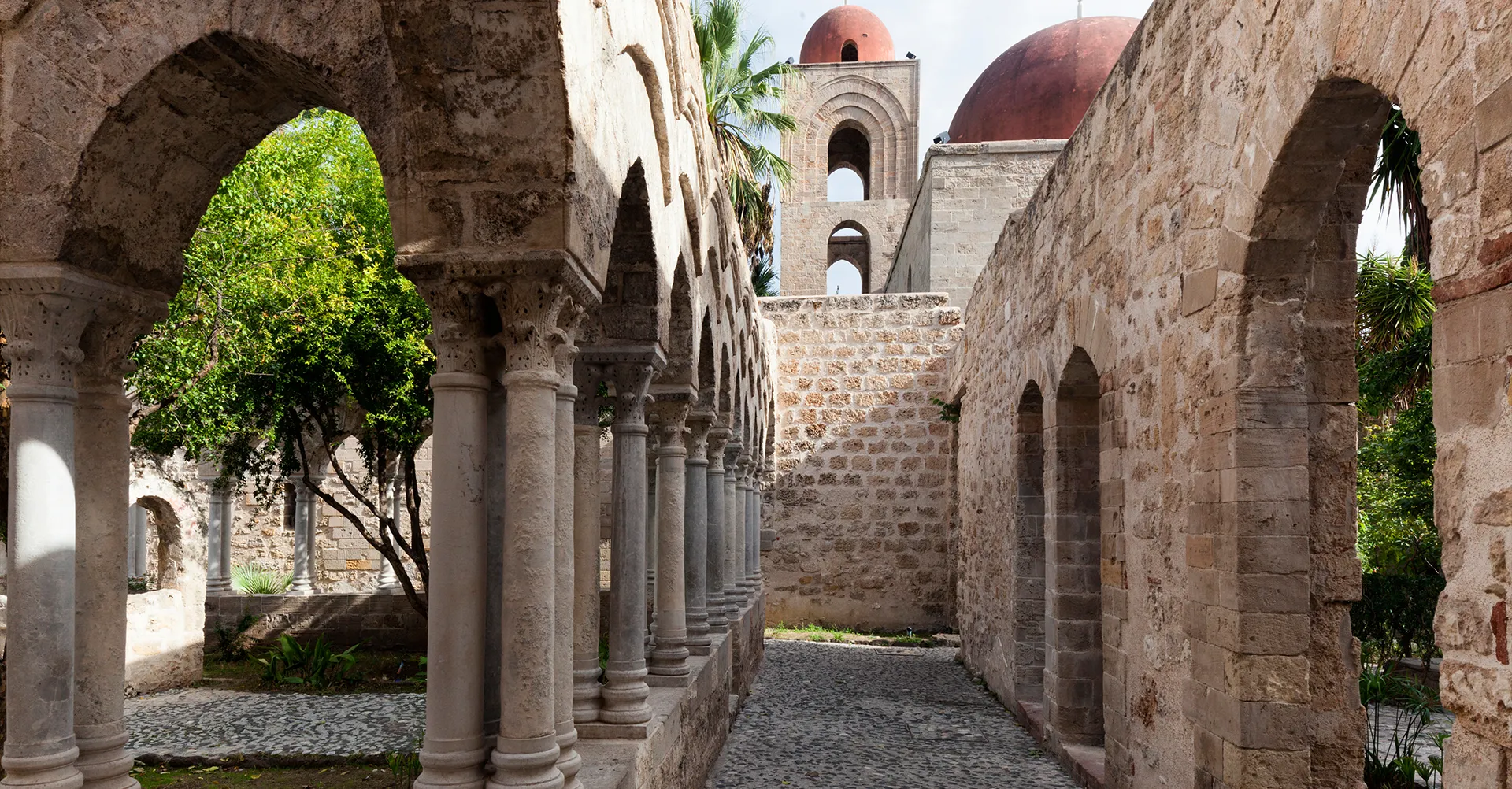
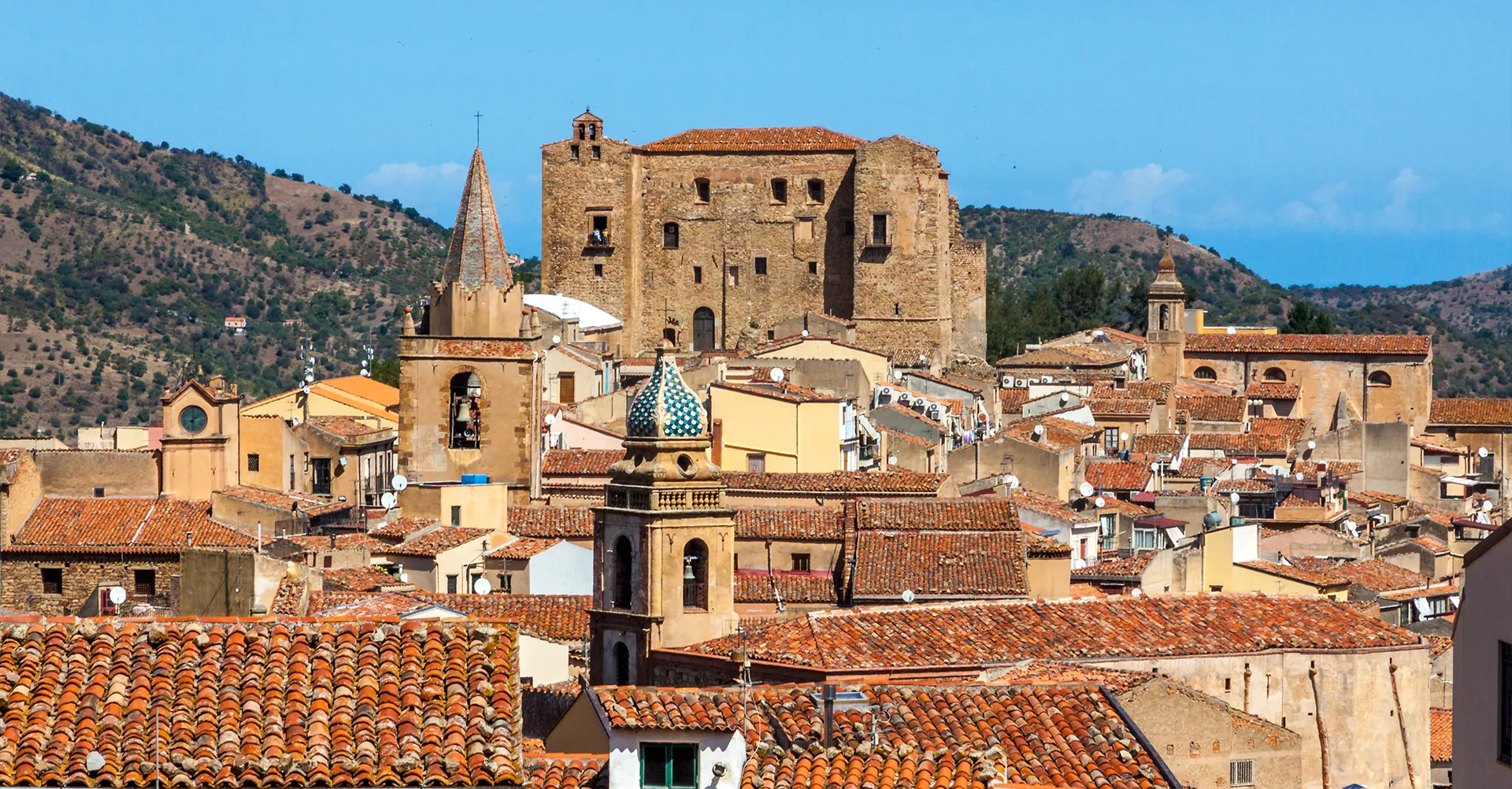
One of the oldest and most evocative villages in the Madonie mountains, Gratteri invites visitors to explore it slowly, through landscapes, architecture, and stories intertwined with legend.
The visit often begins at the Belvedere Ganci Battaglia, a panoramic viewpoint overlooking the entire Tyrrhenian coast and, on the clearest days, even the Aeolian Islands. For this reason, the village is known as the “terrace over the Tyrrhenian Sea.” From here, a walking route leads from the Ecce Homo bridge to Portella Carruba, a place name linked to an ancient carob tree already mentioned in 16th-century sources. Along this stretch, the landscape opens into a harmonious rural scenery, almost like a nativity scene, where green pastures frame the small Church of the Convent, dating back to the 12th century.
Looking further towards the horizon, the valley and the profile of Mount San Calogero become visible, dominating the Gulf of Termini Imerese. The visit continues with the town’s historical and environmental museum, recently renovated and located on a hill overlooking the remains of the original ancient district, once called Terra Vecchia and now known as Conigliera, with its steep cliffs above the so-called “Bocca dell’Inferno”.
Walking through the historic centre, among narrow alleys and stone views, you follow the main street to the Fountain of the Nymph, set in a small green area in front of the Mother Church. Here, visitors are also introduced to the symbolism of the stone shell, linked to the nearby Grattàra Cave and often interpreted as an identity marker of the territory, almost a sign of its “genius loci.”
Among the most important religious landmarks is the Church of San Michele Arcangelo, which preserves relics from Jerusalem and an artistic heritage layered over centuries. After a short break to taste local specialties, the route continues to the Church of San Giacomo, the town’s patron saint, where a highly venerated statue is kept by the local community.
In the area of the homonymous district, visitors also find the poet’s house and a particular stone structure used for collecting rainwater, known as “u cabbubbu,” a testimony to ancient environmental adaptation techniques. From Vicolo San Giacomo, the route enters the district of Via Fiume, where the remains of three medieval bridges and an underground cistern, the so-called Fantina well, can be found. These structures were buried after World War II to modernize the road system. Beneath this area still flows the underground Crati stream, which originates from Pizzo di Pilo and crosses the village, symbolically separating the oldest part from the newer one.
The itinerary ends in Piazzetta Ponte Silvio, where you take the Salita Orologio, formerly known as Via dei Saraceni, a name that recalls the historical layers and various dominations that have shaped the identity of the village.